
Archive
The paper that came with the games, and the advertising that sold them.
The Commodore 64 releases
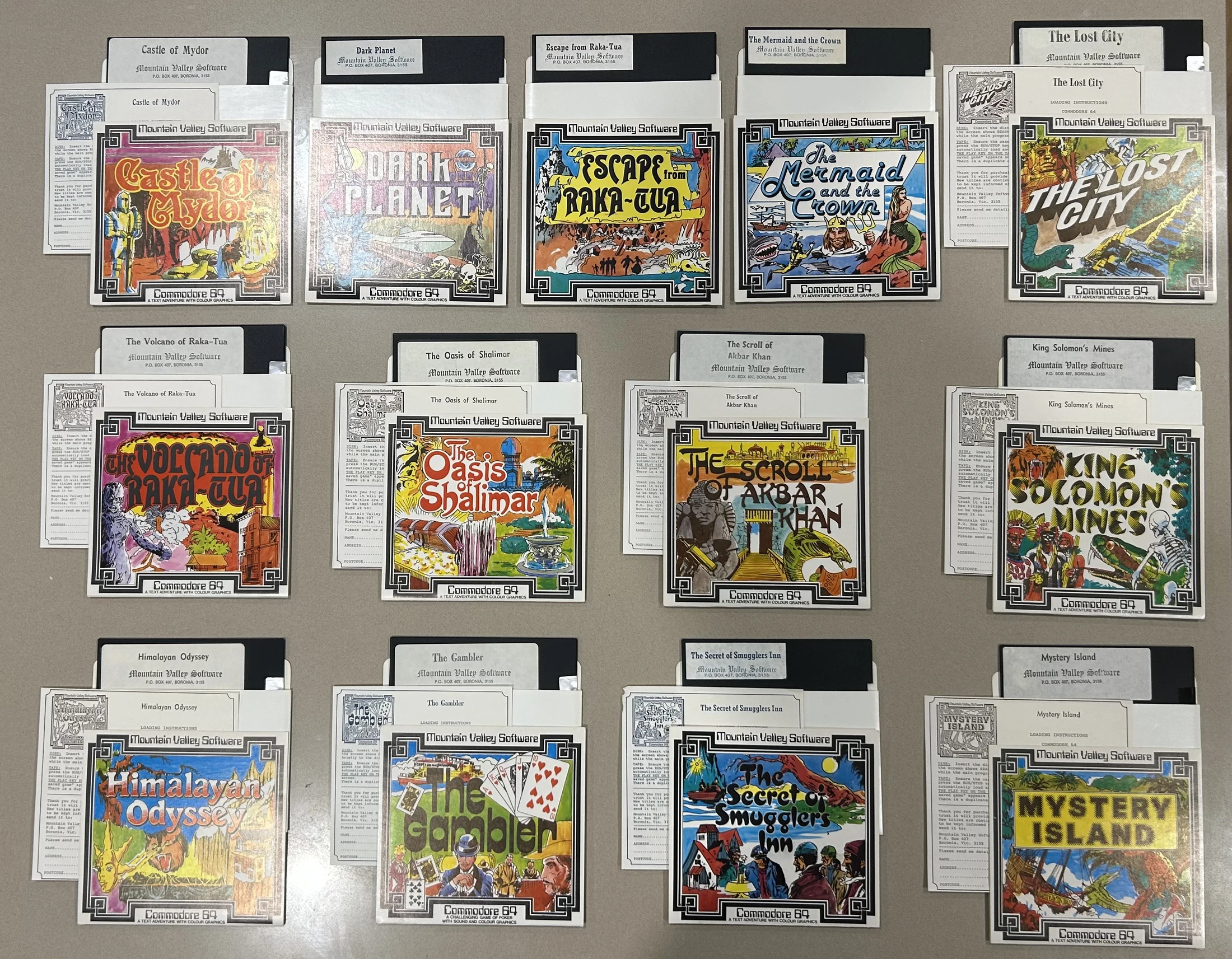
All thirteen, on disk and as they were sold: a printed sleeve in the bordered cover design and a disk labelled with the title and the Boronia address. Most also have a card printed with a line drawing of the cover, carrying the loading instructions and a slip asking the buyer to send in their name and address. No card is shown with Dark Planet, Escape from Raka-Tua or The Mermaid and the Crown.
Catalogue, 1986
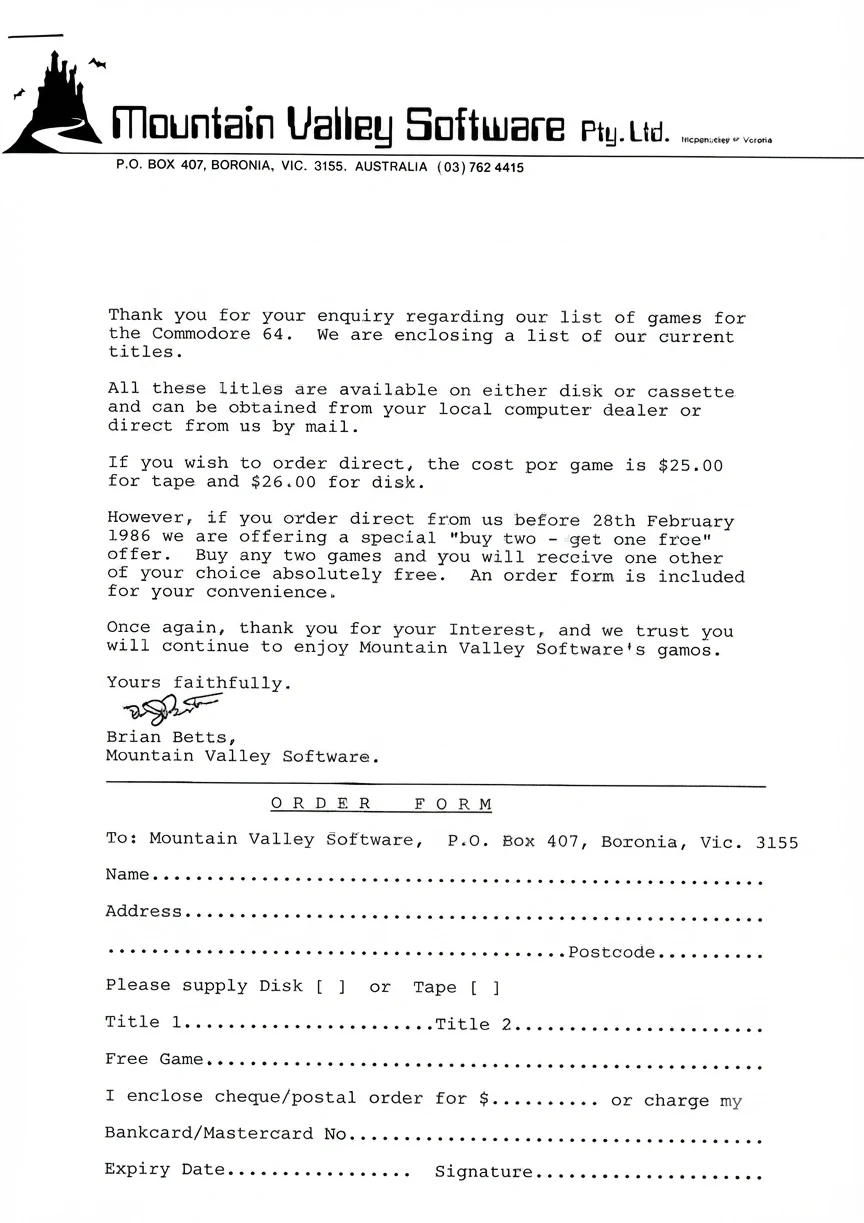
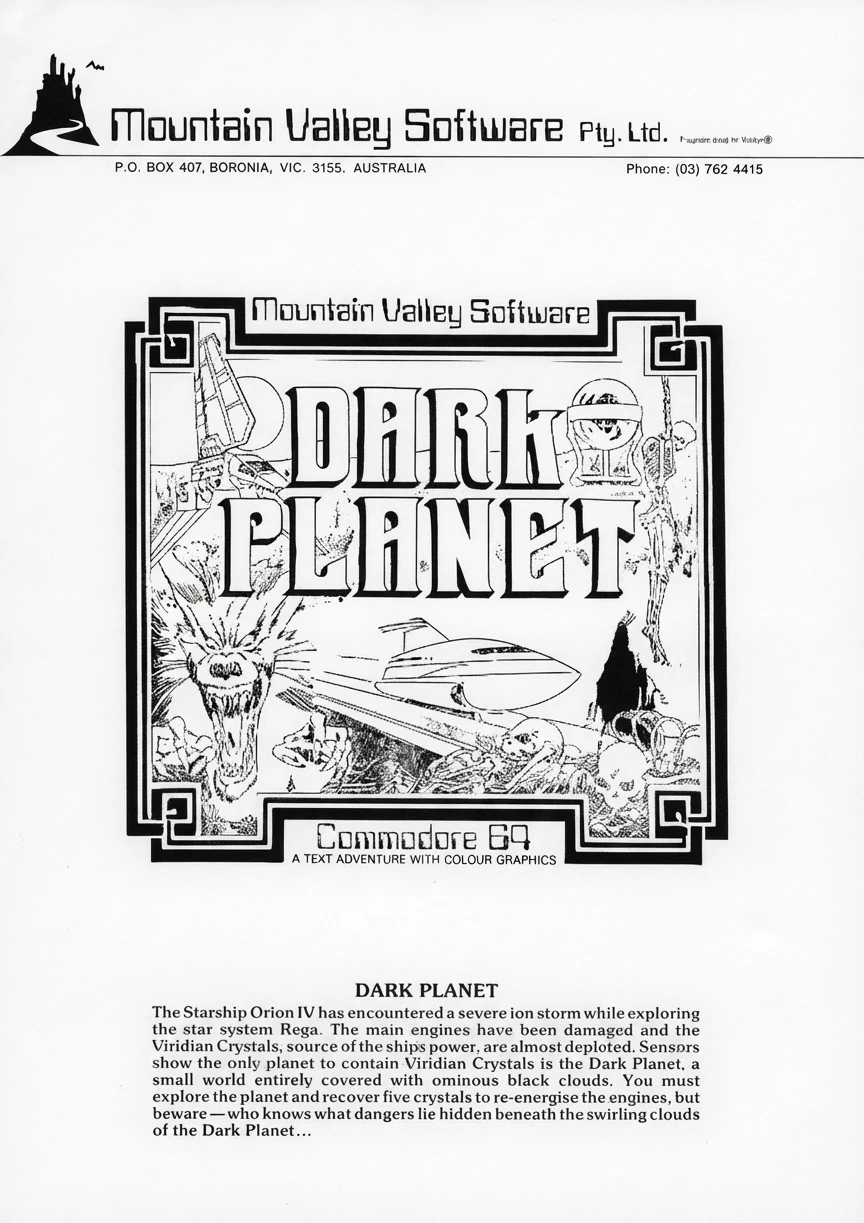
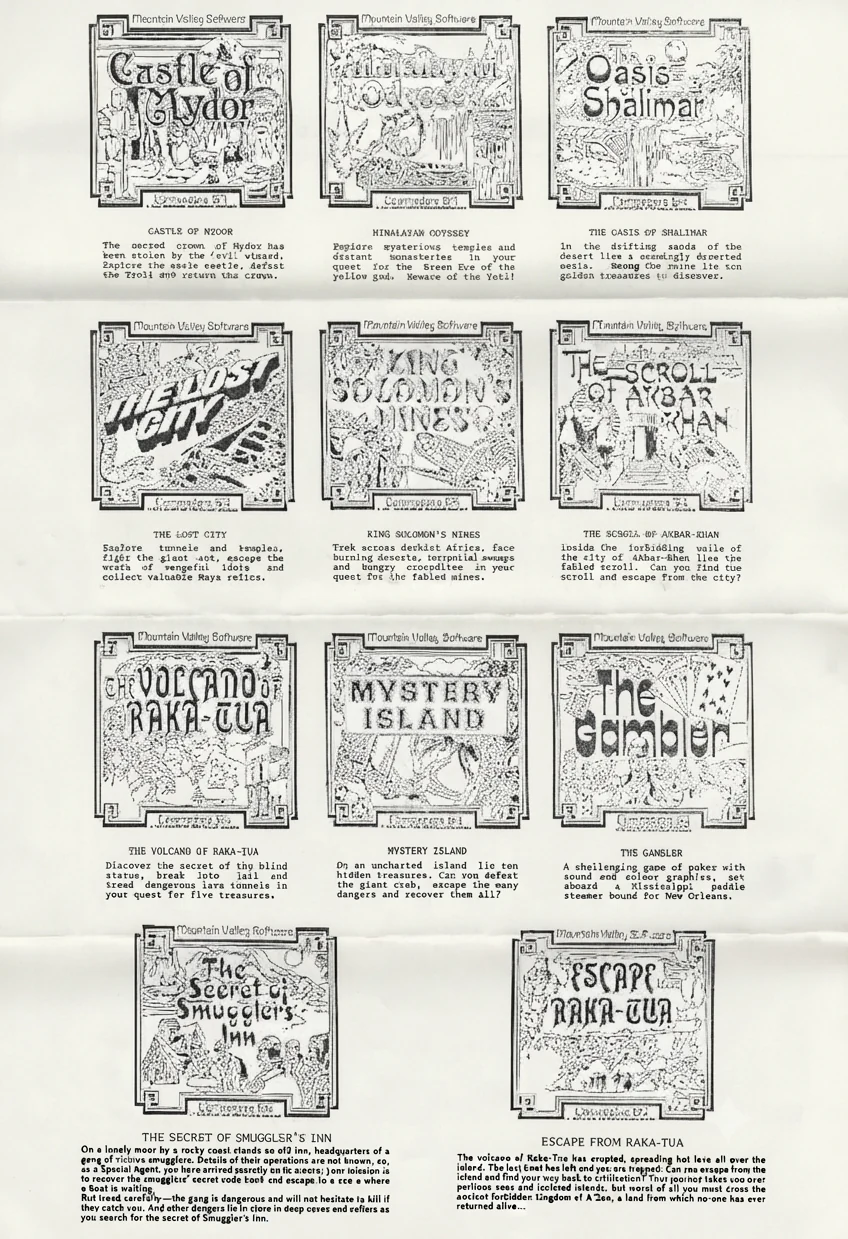
A covering letter signed by Brian Betts, a sheet for Dark Planet, and a fold-out of the range. Games were $25.00 on tape and $26.00 on disk, with a “buy two — get one free” offer running to 28 February 1986.
In the press, 1982
The earliest dated notice of the company found so far: a page of product write-ups placed by The Australian Beginning, the Melbourne online service, in Australian Personal Computer, September 1982. Mountain Valley shares it with Peach microcomputers, the Casio FX 9000P and a 3M teleprinter.
It is worth reading closely. Mountain Valley is called “one of Australia’s newest and most dynamic software companies”, writing for the TRS-80 and the System 80 — the Dick Smith clone sold here — and the range is not only adventures: it lists Superterm, a dumb terminal program, and a test and grading program for schools. Nothing else in this archive records those two. The programs sold through the Electronic Shopping facility of The Australian Beginning and over the counter at Computer Country.

Advertising
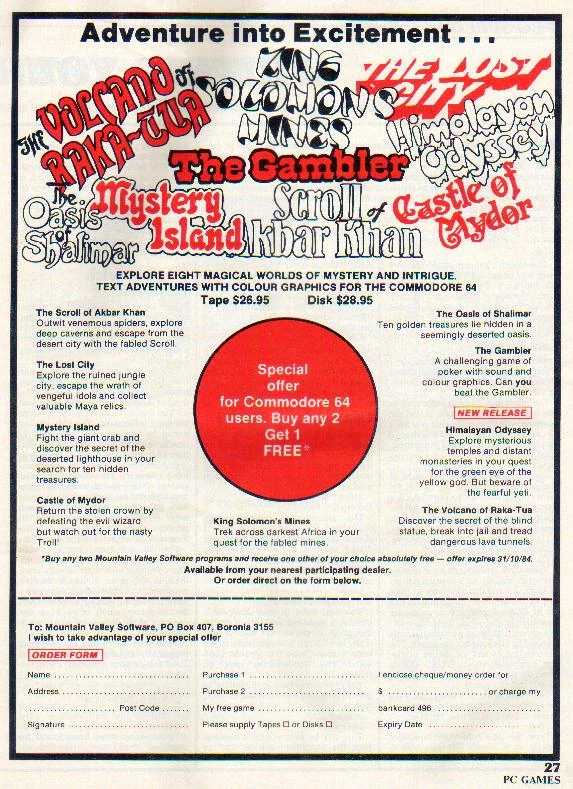
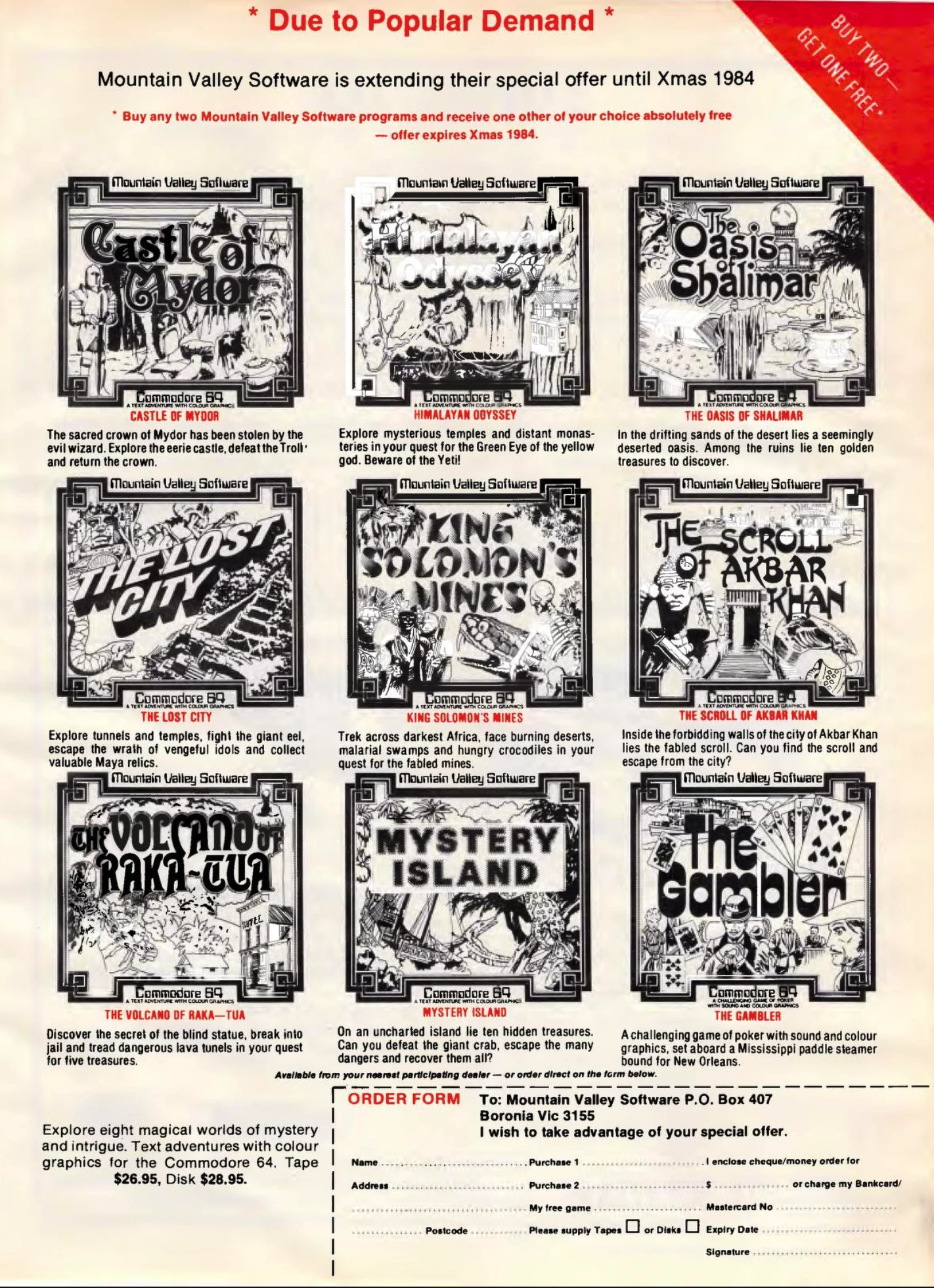
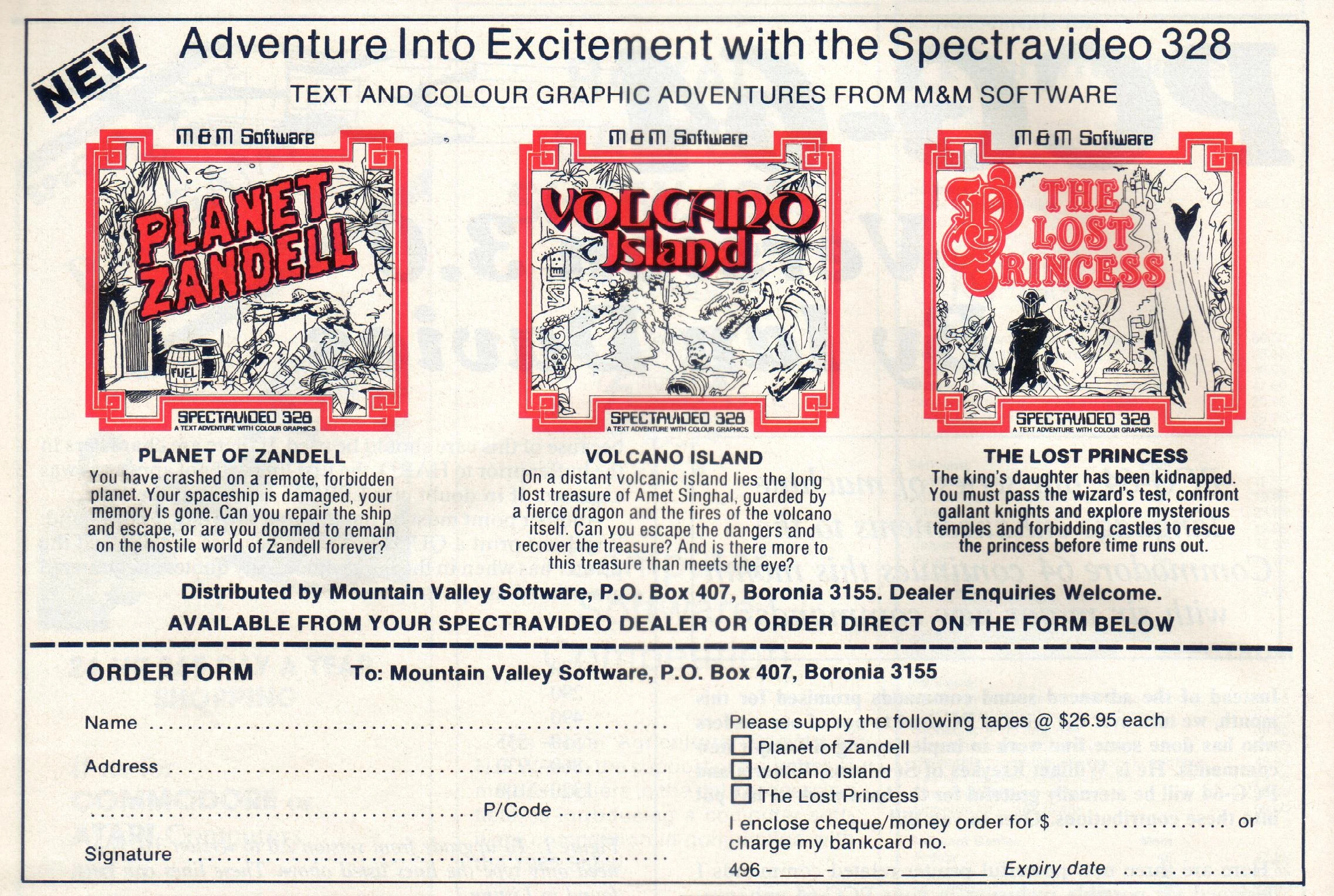
The October 1984 page promises “eight magical worlds” plus The Gambler, bills Himalayan Odyssey as a new release, and prices the range at $26.95 on tape and $28.95 on disk. December’s extends the same two-for-one offer to Christmas and carries the Boronia order form. The third is the Spectravideo 328 launch advert for M&M Software.
The October and Spectravideo pages are from PC Games. The December advert also ran there, on page 12, but the copy shown here is a later and much better scan that was trimmed to the advert’s own border, so it carries no masthead of its own.
The October 1984 campaign
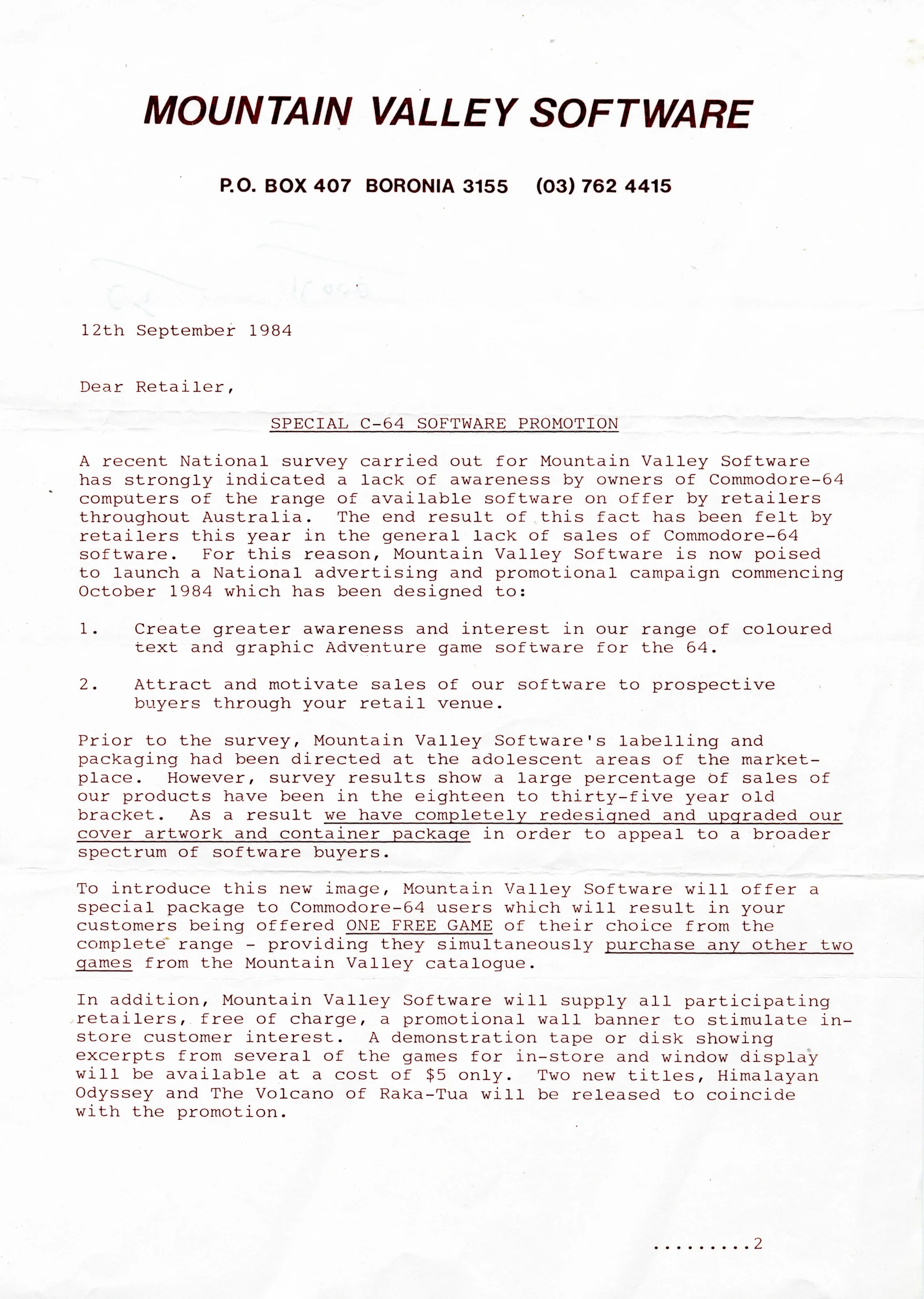
On 12 September 1984 Mountain Valley wrote to dealers announcing a national advertising and promotional campaign from October. A survey had found that most buyers were eighteen to thirty-five, not the adolescents the packaging had been aimed at, so the cover artwork and packaging had been “completely redesigned and upgraded”. Customers who bought any two games got a third free. Participating shops got a wall banner free, and could buy a demonstration tape or disk of excerpts for in-store display for $5. Himalayan Odyssey and The Volcano of Raka-Tua were released to coincide. The October and December adverts above belong to the same campaign.
The dealer letter ends “…2”. Its second page has not surfaced. The demonstration disk has, and it is on the Demo page, beside its unused label here.
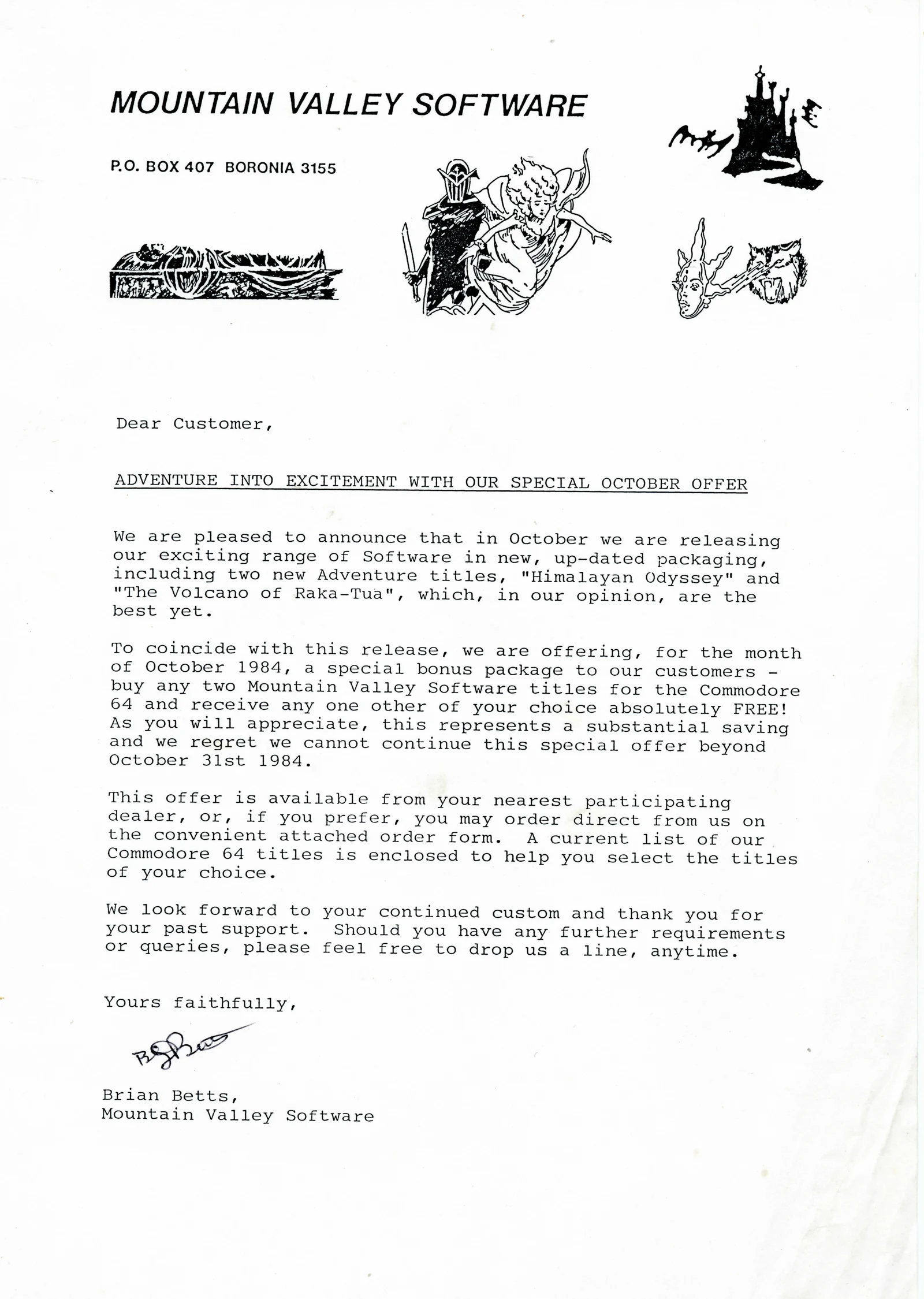
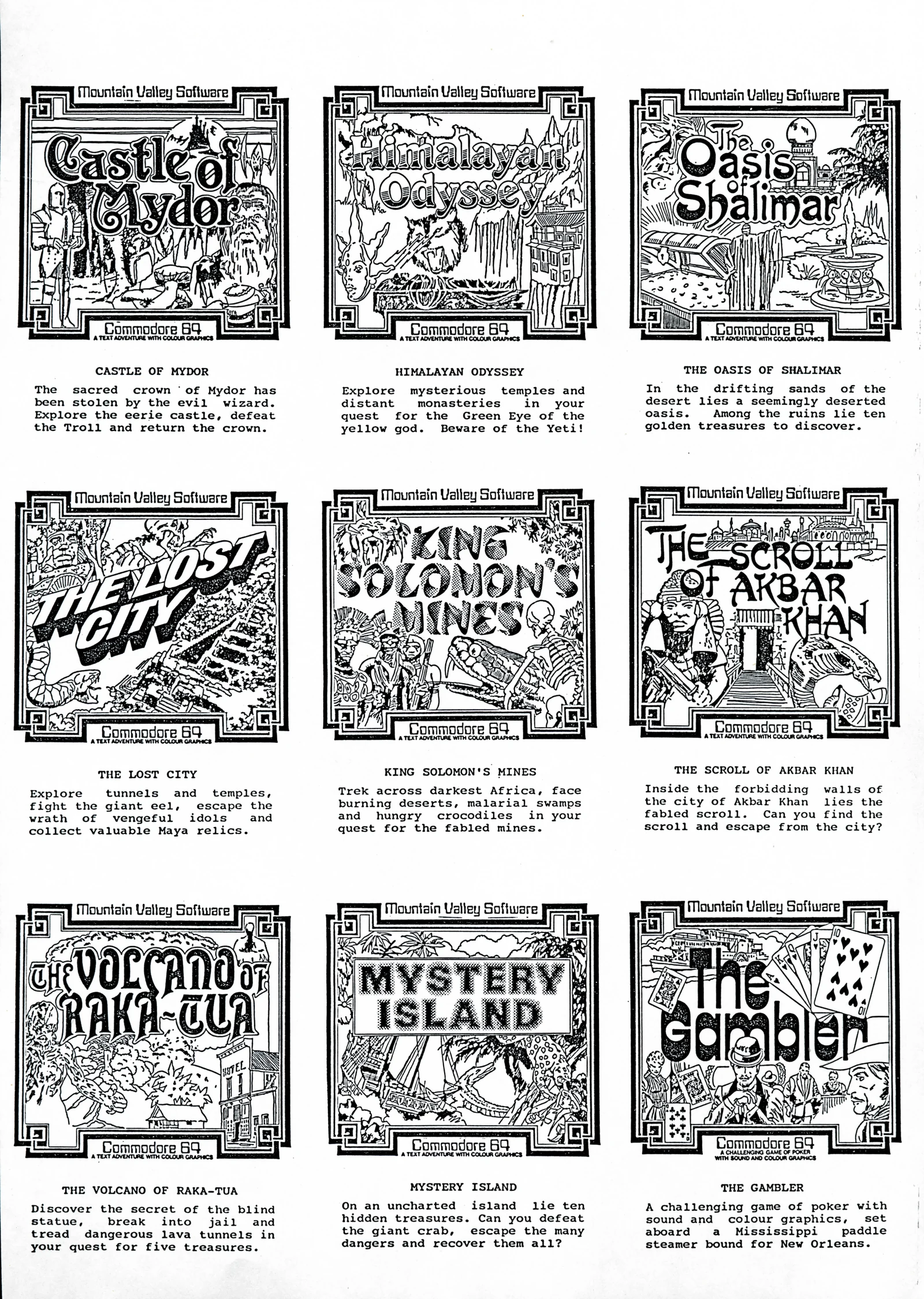
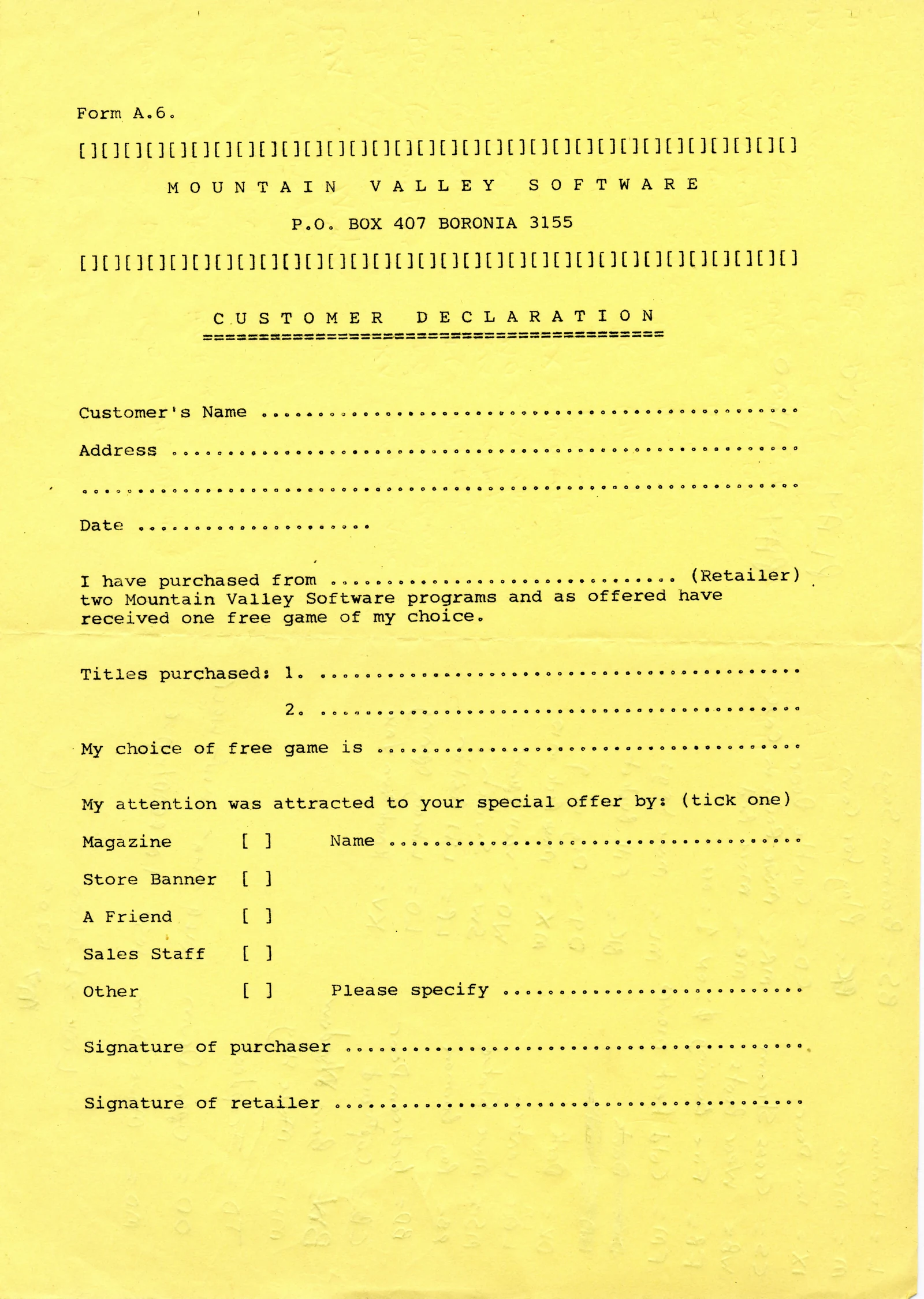
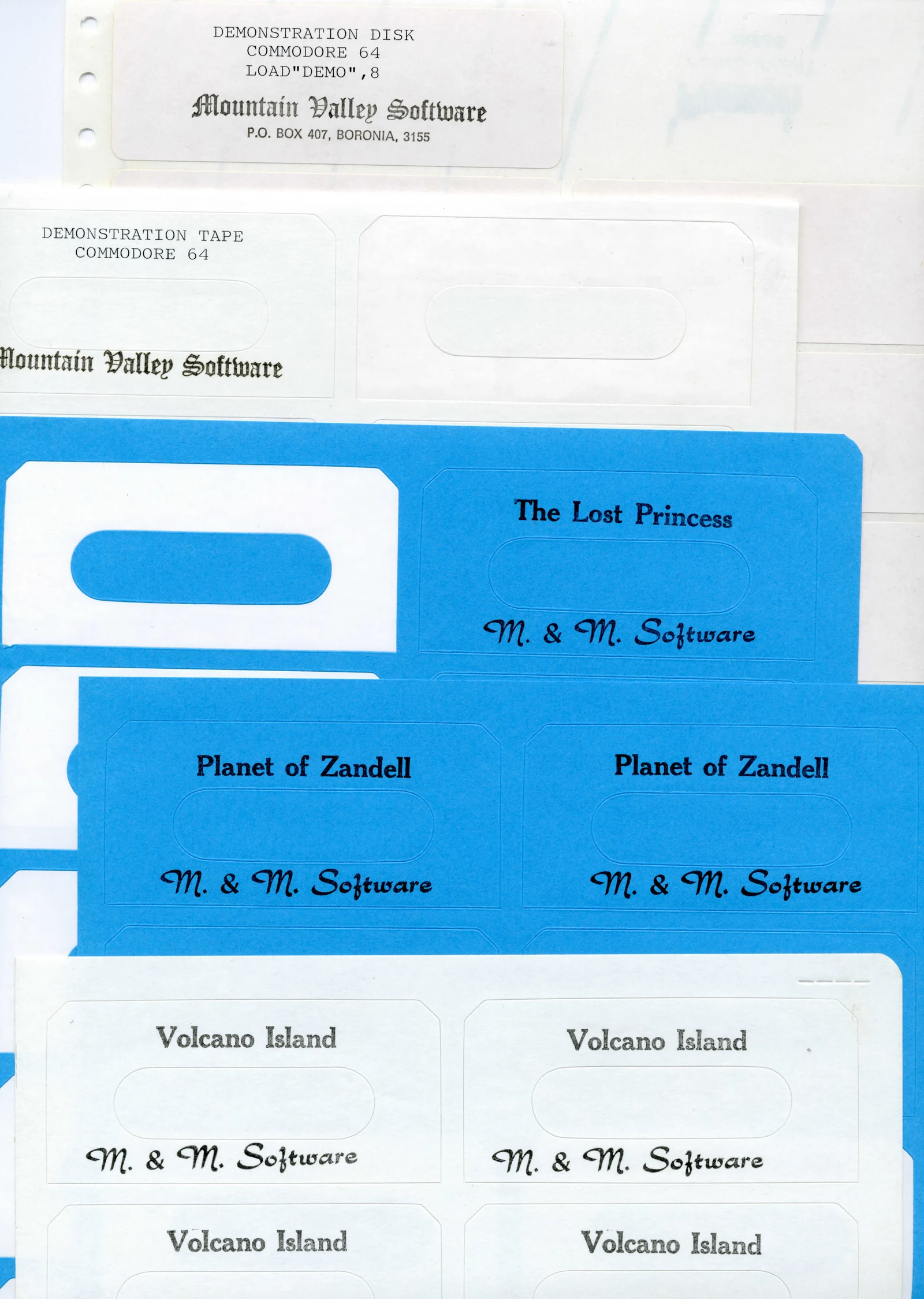
The list of nine titles is most likely the “current list of our
Commodore 64 titles” that the customer letter says is enclosed. It has both new
releases and none of the 1985 titles. It also shows which cover design is the new one: the
bordered line art. The unbordered design on seven of the game pages is most likely the
packaging it replaced. The demonstration disk label reads LOAD"DEMO",8. The Zandell label
reads Planet of Zandell, the title the game’s own title screen gives
it.
Reviewed
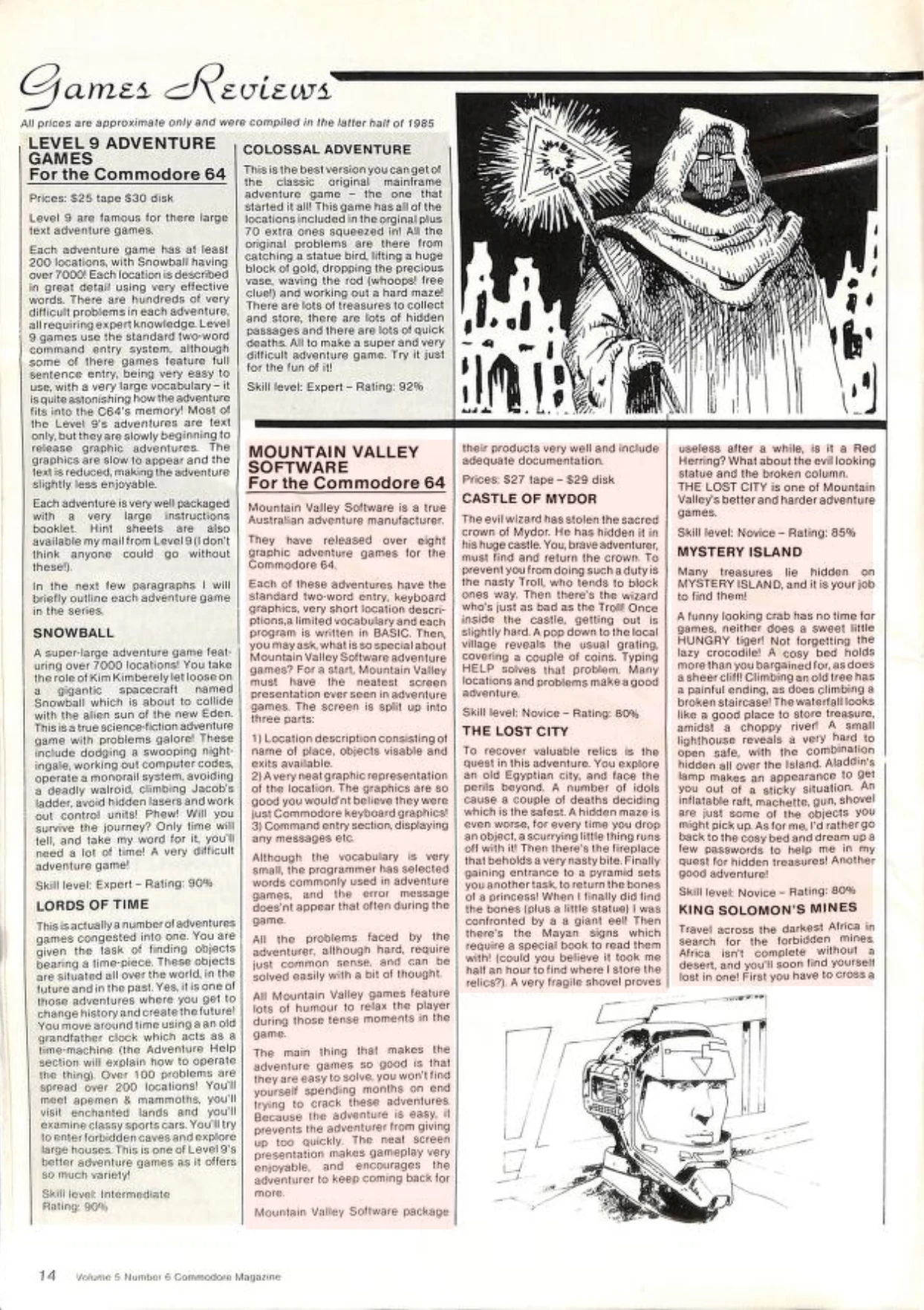
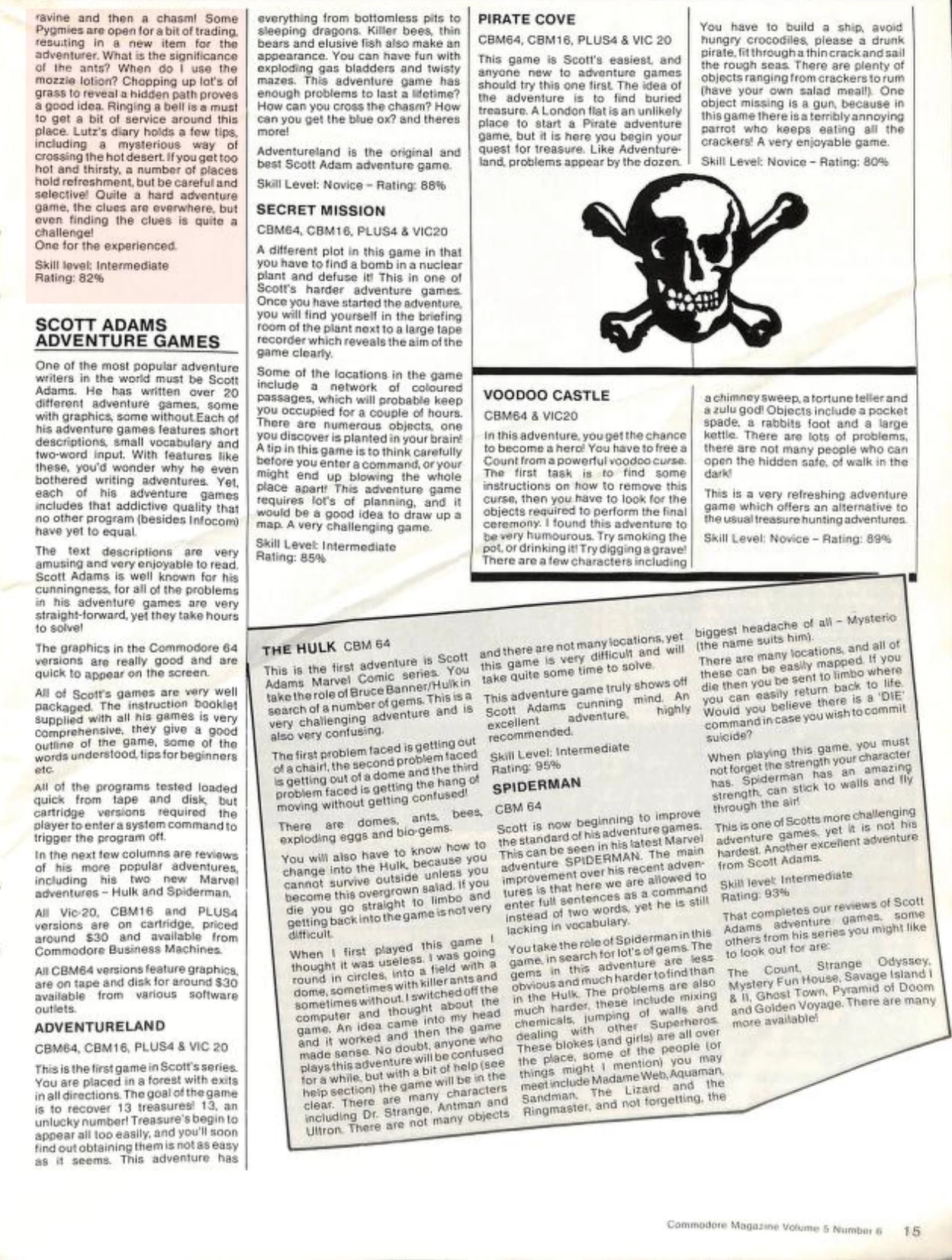
Four of the adventures reviewed together in Commodore Magazine, volume 5 number 6, across pages 14 and 15. The page notes that its prices “were compiled in the latter half of 1985”. Mountain Valley is set alongside Level 9 and Scott Adams — company Betts would have been pleased with — and called “a true Australian adventure manufacturer” with “over eight graphic adventure games” out for the Commodore 64, at $27 on tape and $29 on disk.
The reviewer rates The Lost City 85%, King Solomon’s Mines 82%, and Castle of Mydor and Mystery Island 80% each, singles out the three-part screen as “the neatest screen presentation ever seen in adventure games”, and notes that every one of them is written in BASIC. The two reviews that stood on this site from 2007 were transcribed from this page, without its ratings; this is the page itself.
In Britain: Zzap!64, August 1985
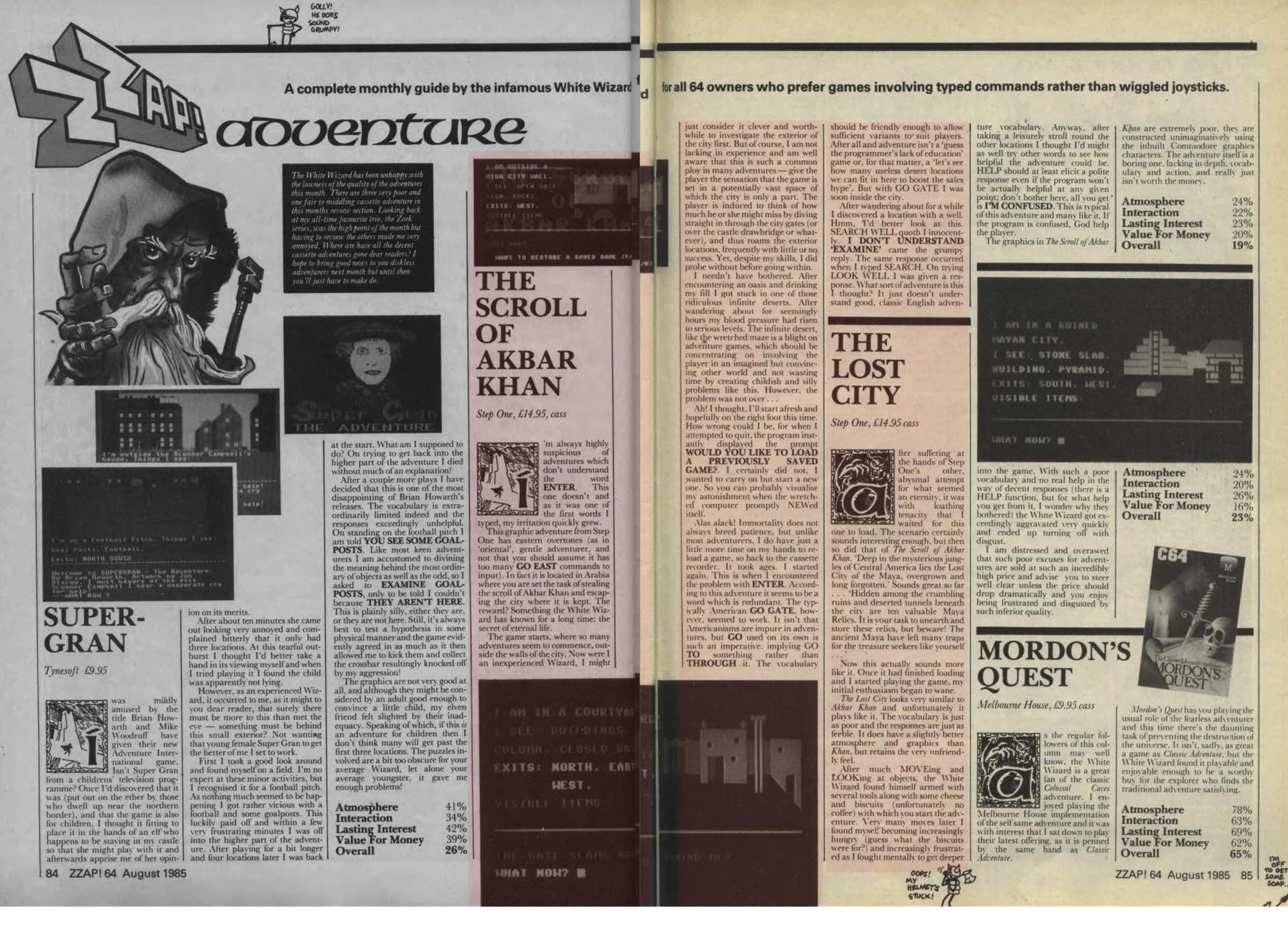
Two of the games also reached Britain, sold there by Step One at £14.95 on cassette. The UK magazine’s adventure columnist, the White Wizard, reviewed both in August 1985 and hated them. The Scroll of Akbar Khan scored 19% overall: “a boring one, lacking in depth, vocabulary and action, and really just isn’t worth the money”. The Lost City scored 23%. Its scenario “certainly sounds interesting enough” (he quotes the inlay blurb), but “the vocabulary is just as poor and the responses are just as feeble”. They are Betts’s games: the rooms in the magazine’s screenshots, “a high city wall” and “a ruined Mayan city”, are on the Mountain Valley disks. In Commodore Magazine, above, the same game scored 85%.
The Adventure Notepad
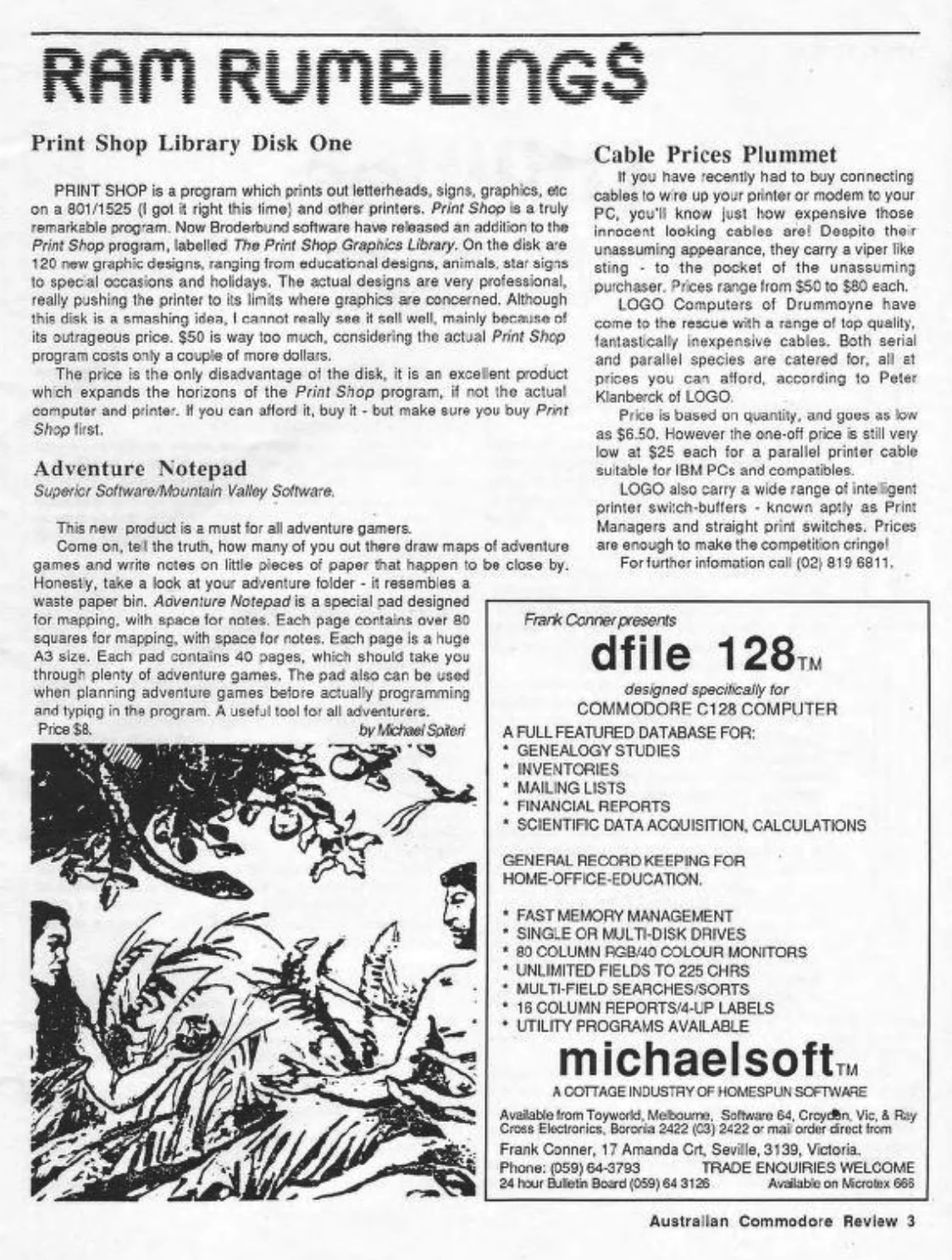
Not a game. Australian Commodore Review reviewed an Adventure Notepad, credited to “Superior Software/Mountain Valley Software”, in its “Ram Rumblings” column. It was a pad of forty A3 pages for mapping adventures, each page “over 80 squares for mapping, with space for notes”, that “also can be used when planning adventure games before actually programming”, much as Betts’s own notebook grids were. It cost $8. Michael Spiteri wrote the review: “a must for all adventure gamers”. The page carries no date, but it advertises a database for the Commodore 128, so it is no earlier than 1985. No copy of the pad is known.
Playing the games
Fifteen original disk images survive and each is linked from its
game’s page under “From the archive”. They are plain .d64
files: open one in VICE, which
is free for Windows, macOS and Linux, or copy it to a THEC64.
Two further disk images on this site are not originals. One is a present-day conversion of the 1981 TRS-80 game The Secret of Flagstone Manor to Commodore 64 BASIC. The other is a new Commodore 64 game written in 2026 from Betts’s design notebook for Forbidden Valley, whose original does not survive. Each is offered on its own page and labelled there. Mountain Valley never released either title for the Commodore 64.
Hint sheets
Mountain Valley sold a hint sheet for each adventure. Eleven survive, and each one is linked from its game’s page under “From the archive”. They contain solutions — open them only if you mean to.